
EXECUTIVE LEADERSHIP DEVELOPMENT THROUGH DOG-GONE LEADERSHIP
A Different Way to See Leadership
An unexpected lens. A very practical way to understand leadership.
Leadership doesn’t begin when we walk into the office and end when we leave.
It shows up in how we communicate, respond under pressure, build trust, set expectations, create boundaries, adapt to others, and influence the environment around us.
In other words, leadership is behavior.
And sometimes the easiest way to see that behavior clearly is to look somewhere completely different.
For me, that place has always been our relationship with dogs.
Dog-Gone Leadership uses the everyday interactions between people and dogs as an unexpected lens for exploring the very human dynamics of leadership.
What Got You Here Matters. It Just Isn’t Enough.
Most successful leaders got where they are because they are good at what they do. They think strategically. They solve problems. They make decisions. They understand their business and know how to produce results.
Those capabilities matter.
“What got you here won’t get you there.”
– MARSHALL GOLDSMITH
At a certain level of leadership, what you know matters just as much as how you show up.
A leader can be a brilliant strategist and struggle to build trust. Someone can make the right decision and create unnecessary resistance because of how it is communicated. A leader can value accountability while unintentionally creating an environment where people are afraid to admit mistakes.
Technical and cognitive capabilities create tremendous value.
Behavior determines how fully that value can be realized.
From the Neck Up. From the Neck Down.
Workplaces tend to be highly cognitive environments. We analyze, strategize, measure, solve, perform, and decide. Those things are essential.
But workplaces can also be places where people become guarded. When trust is low or leadership is unpredictable, people protect themselves. They become careful about what they say, what they question, and what they reveal.
Then many of us go home to our dogs and the armor comes off.
Especially for leaders carrying significant pressure all day, the dog may be the one relationship where they don’t want another problem to solve. They want affection, companionship, and ease.
Sometimes that pendulum swings too far. Expectations become unclear. Boundaries disappear. Behaviors get tolerated because dealing with them requires energy we simply don’t feel like spending.
One world can become all head. The other, all heart.
Neither is the goal.
Effective leadership requires access to both. It means being aware enough to recognize what the moment calls for and flexible enough to respond accordingly.
Sometimes empathy. Sometimes clarity. Sometimes patience. Sometimes a boundary.
Leadership isn’t black and white. There are a lot of colors in between.
PERSONAL HISTORY
The Dog in Front of You Matters
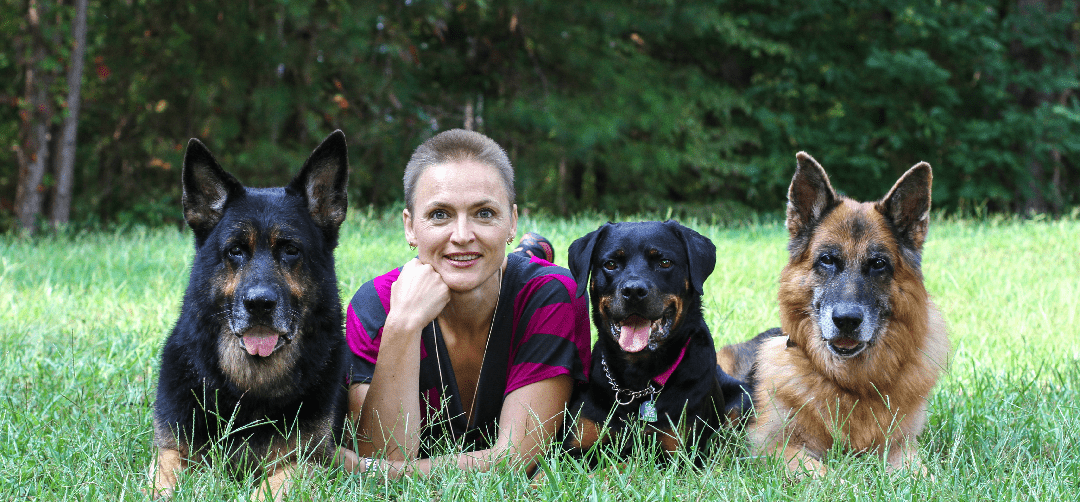
My first dogs were two German Shepherds, Cito and Barko. I raised, trained, and competed with them and learned a great deal along the way.
Then I became involved in dog rescue.
My first foster dog was Shelby, a three-legged Rottweiler who had experienced significant trauma. She had lived on a chain and lost part of her leg after becoming caught in an animal trap. I eventually adopted her.
Shelby required something different from me.
Many of the approaches that had worked beautifully with Cito and Barko didn’t work nearly as well with her. I had to become more creative, more patient, and more willing to experiment. Most importantly, I had to stop comparing her to the dogs who came before her.
I had to meet Shelby where she was, not where I wanted her to be.
The many foster dogs who followed reinforced that lesson.
And it is just as relevant to leadership.
People aren’t interchangeable. One team member may thrive with considerable autonomy. Another may need more direction while confidence develops. One person may need encouragement. Another may need a clear challenge.
The principles can remain consistent while the approach changes.
Good leadership isn’t about treating everyone the same. It is about recognizing who is in front of us and creating the conditions that allow them to bring forward their best.
BEHAVIOR IS ALWAYS COMMUNICATING
BEHAVIOR
IS
CULTURE.
Behavior creates expectations. Expectations become patterns. And over time, those patterns become culture.
In dog training, I often say that we are either reinforcing what we want or reinforcing what we don’t want.
That is why every interaction counts.
The same principle becomes visible in organizations.
Leaders teach people what to expect through what they consistently do, tolerate, reward, ignore, and reinforce.
Years ago, I interviewed the team of a leader who was struggling.
They told me they could tell what kind of day they were going to have by the way his hair was combed when he entered the office.
Before he said a word, they were already reading him.
Could they approach him? Was he angry? Was it safe to bring him a problem?
Imagine the energy that requires.
Instead of putting their full attention into the work, they were putting part of it into managing the leader.
Behavior creates expectations. Expectations become patterns. And over time, those patterns become culture.
Change the Environment,
Change the Exercise
A dog may perform a behavior beautifully in the living room and struggle with the same behavior outside, where distractions are greater.
“But he knows this.”
Yes. Under calm conditions.
People are affected by conditions too.
Someone can struggle under one leader and flourish under another. A person who speaks openly with one group may become quiet in another. Someone labeled an underperformer in one environment may thrive when the conditions change.
Environment includes circumstances, expectations, relationships, and people.
And leaders are part of that environment.
Our behavior can create more confidence or more fear, more clarity or more confusion, more ownership or more dependence.
Instead of only asking, “What’s wrong with this person?”, leadership sometimes requires us to ask a more useful question:
“What part of the environment am I creating?”
Leadership Becomes Easier to See
This is where Dog-Gone Leadership becomes more than an interesting analogy.
It becomes a way of learning.
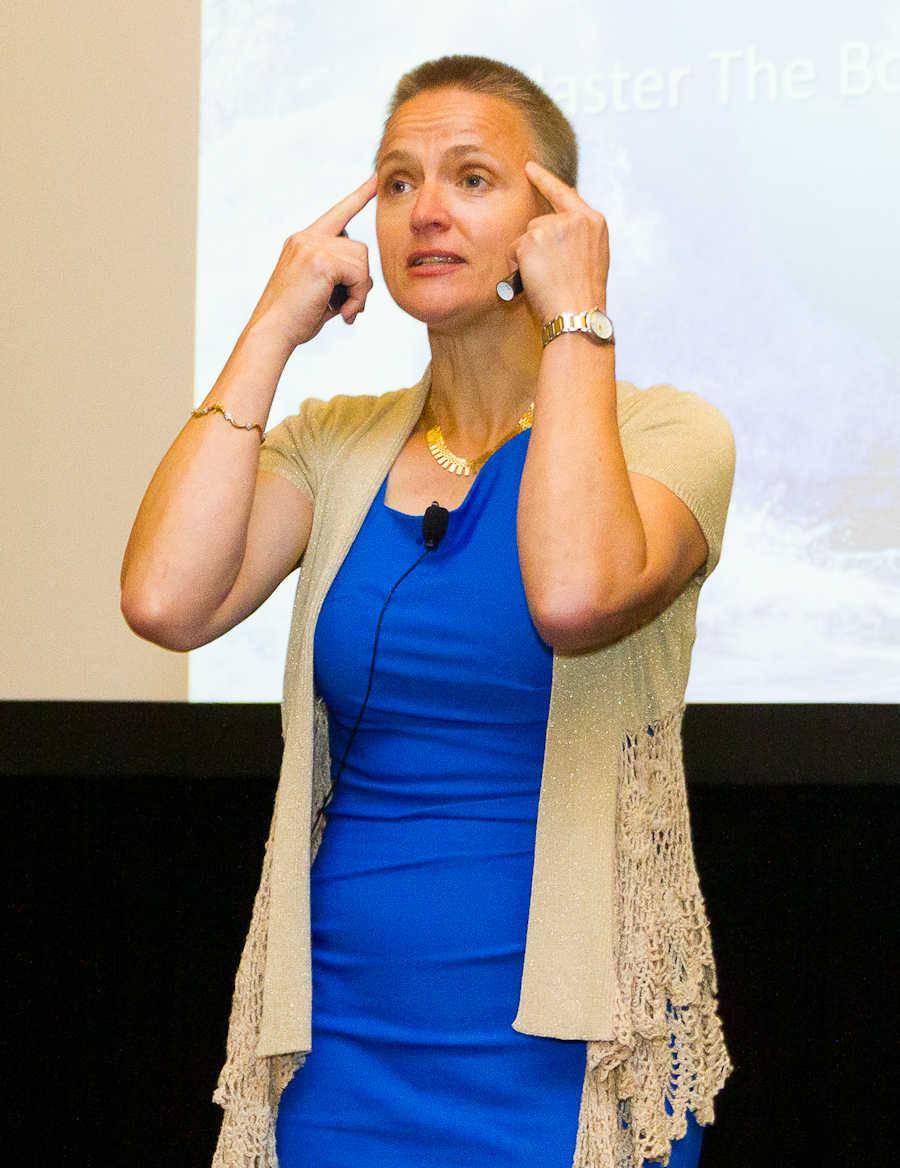
In my programs, we may be exploring emotional regulation, communication, influence, trust, consistency, adaptability, accountability, self-awareness, or other leadership capabilities.
But instead of approaching those subjects only through workplace scenarios and abstract leadership models, I begin somewhere more familiar.
We can learn as much from what is working as we can from what isn’t.
These stories change the energy in the room. People laugh. They recognize themselves. They offer their own examples. Something that could have remained intellectual suddenly becomes tangible.
Then we bring it back to leadership.
The dog isn’t the leadership lesson.
The interaction helps us see the leadership lesson more clearly.
And once we see it, it becomes harder to unsee.
Leadership Development, Built Around Your Organization
Dog-Gone Leadership isn’t a standardized program with the same curriculum delivered to every group.
The starting point is your organization.
What is happening with your leaders and teams? Where are people getting stuck? What behaviors are affecting trust, communication, accountability, performance, or culture? What would you like to strengthen?
From there, I customize the experience around the leadership capabilities that matter most.
That might include:
Emotional Regulation · Communication · Trust · Influence · Accountability · Adaptability · Consistency · Self-Awareness · Team Dynamics
The leadership challenge determines what we explore.
Dog-Gone Leadership gives us a different lens through which to explore it.
PROGRAM FORMATS
Ways to Bring It Into Your Organization
You don’t need to own a dog.
You don’t even need to consider yourself a “dog person.”
You simply need to be willing to look at leadership from a different angle.
Leadership Is Everyday Behavior
Leadership doesn’t switch on when we arrive at work and switch off when we leave.
It is present in how we communicate, how we respond, how we handle emotion, how we create boundaries, how we adapt, how we build trust, and how we help others grow.
Dogs simply give us another place to observe those behaviors. A place that can feel lighter, more familiar, and sometimes much easier to see.
Dog-Gone Leadership is the practice of creating the relationships, environments, and experiences that allow the best in ourselves and others to emerge.
What might become visible when you look at leadership differently?