
LEADERSHIP TEAM COACHING
Leadership teams spend countless hours working on the business.
Far fewer are working on how they work together.
Yet how a leadership team communicates, makes decisions, navigates disagreement, and builds trust ultimately shapes how effectively the business moves forward.
Most teams don’t intentionally create unhealthy patterns. They develop gradually through everyday interactions, assumptions, habits, and behaviors that go unnoticed because everyone is focused on the work itself.
Over time, those patterns begin to influence how the team functions.
Conversations become more cautious—or more frustrating—than they need to be. Decisions take longer. Opportunities are missed. Trust begins to erode in subtle ways. The team continues to perform, but the work starts to feel heavier than it should.
This doesn’t mean the team is broken. In fact, many of the leadership teams I work with are highly successful. They’ve simply reached a point where the way they work together deserves the same level of attention as the business they’re leading.
WHERE THIS SHOWS UP
Most leadership teams don’t experience one defining moment that tells them something needs attention.
Instead, it shows up in the everyday interactions that gradually shape how the team works together.
Over time, these patterns affect more than communication. They influence trust, decision-making, innovation, accountability, and the team’s ability to leverage the strengths and expertise already within the room.
The work doesn’t necessarily become harder because of the business itself. It becomes harder because the team isn’t fully using the collective wisdom it already has.
COACHING APPROACH
A Different Way to Work Together
Healthy leadership teams don’t avoid disagreement. They challenge one another’s thinking, bring different perspectives to the table, and ask difficult questions because they know better decisions emerge when ideas can be explored openly.
That kind of dialogue doesn’t happen by chance. It requires trust—the confidence that differing opinions won’t be taken personally, but received as a shared effort to move the team and the organization forward. It also requires communication that is intentional, respectful, and clear enough for messages to be heard in the way they are intended.
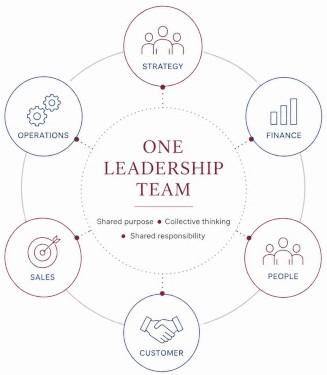
As trust grows, something else begins to change. Leaders naturally become more curious about one another’s perspectives and expertise. They move beyond the boundaries of their own functional areas and begin thinking as one leadership team rather than as individual leaders representing separate parts of the organization.
Instead of asking,
“How do I solve this within my area?”
the conversation becomes,
“How do we solve this together?”
That’s where the real opportunity lies. Leadership teams often hold far more collective wisdom, experience, and creativity than they fully realize. When people intentionally draw on one another’s strengths, new possibilities emerge, better decisions are made, and the team becomes stronger than the sum of its individual members.

What Begins to Change
When a leadership team works intentionally on how it functions together, changes begin to emerge in five interconnected areas. These are not independent outcomes — they reinforce one another.
The team doesn’t become stronger simply because people communicate better. It becomes stronger because the people around the table learn to lead themselves and one another differently.

A DIFFERENT LENS
Behavior Communicates More Than We Realize
One of the unique perspectives I bring to this work comes from observing behavior across very different environments.
For more than two decades, I’ve coached leaders and leadership teams while also observing behavior through my work with dogs.
Dogs respond to what we actually communicate, not what we intend to communicate.
That same is true in leadership teams.
The patterns that shape trust, collaboration, influence, and decision-making are often communicated through everyday behaviors that have become so familiar they’re no longer noticed.
When those patterns become visible, teams gain the opportunity to make different choices.
Often, meaningful change begins not by adding another model or tool, but by seeing familiar interactions through a different lens.
Leadership in Practice
From Better Communication to Shared Purpose
A CEO reached out because he believed his leadership team had a communication problem. Meetings were frustrating, conversations lacked energy, and the team wasn’t operating as cohesively as he wanted.
READ THE STORY
As I met individually with each team member, a different picture began to emerge. Communication wasn’t the root issue. The team had lost sight of its shared purpose. Everyone was focused on achieving results, but they were not united around how they wanted to work together as a leadership team.
Once that foundation became clear, the conversations changed naturally. Together, the team identified how they could better leverage one another’s strengths, have more meaningful strategic discussions, and create meetings that encouraged collaboration rather than simply exchanging updates.
Sometimes the greatest shift isn’t improving communication. It’s creating the shared foundation that allows better communication to happen naturally.
Moving Beyond Silos
Another executive was frustrated that too much continued to flow through him. Team members relied on him to connect ideas, answer questions, and bridge conversations that could have been happening directly with one another. Although the leaders worked well individually, they rarely drew on the experience and expertise already sitting around the table.
READ THE STORY
Through our work together, the team began recognizing something important. While each leader faced different responsibilities, many of the underlying leadership challenges were remarkably similar. Once they saw those common threads, conversations became more open, people sought one another’s perspectives more naturally, and the team began relying less on the leader as the central connector.
Instead of approaching challenges from within their own functional areas, they started thinking more collectively, drawing on the knowledge and experience already within the team.
Leadership teams become stronger when they stop relying on one person to connect the dots and begin discovering the strength that already exists among them.
HOW IT STARTS
Every leadership team is different, so the work begins with understanding what’s happening in yours.
Our first conversation is simply an opportunity to explore what you’re experiencing, what you’ve observed, and what you hope will be different. There is no cost and no pressure to move forward.
If it feels like a good next step, we’ll schedule a working session focused on your team and the challenges you’re navigating. This allows you to experience my approach while we determine together what kind of support would be most valuable.
If we decide to continue, we’ll design an engagement around your team, your goals, and the outcomes you want to achieve. That may include individual conversations, leadership development workshops and training, facilitated team sessions, retreats, observations, or a combination of approaches tailored to your team’s needs.