
“Did the conversation resolve the issue at hand and make your relationship stronger?”
That was the question I asked Bill, a physician and department chief at a local hospital, whom I met at a social event. We had been casually talking about our work, his role as a leader and mine as a leadership coach, when he told me about a frustrating meeting he’d had with the hospital CEO the previous week.
When I asked him that question, he didn’t even pause.
“No.”
He went on to describe what had happened. Both men had walked into the conversation with strong opinions. Neither felt heard. The frustration kept building until eventually they were yelling at each other.
Two accomplished leaders. One important issue. Plenty of expertise in the room.
And absolutely nothing moved forward.
That’s the interesting thing about a breakdown in communication. It often isn’t caused by people who don’t know how to communicate. It happens between smart, capable people who become so committed to their own position that they lose their ability to hear the person sitting across from them.
The three levels of conversation
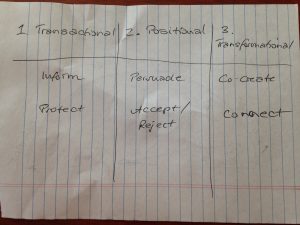
At the party, I asked someone for two pieces of paper. On the first, I wrote:
Three Levels of Conversation
- Transactional
- Positional
- Transformational
The framework comes from Conversational Intelligence® (C-IQ), developed by Judith E. Glaser. I’ve been trained and certified in Conversational Intelligence, and its principles continue to influence how I work with leaders today.
C-IQ distinguishes between three different ways we interact. Level I, Transactional Conversations, are primarily about exchanging information. We tell and ask. Level II, Positional Conversations, are where we advocate and inquire, often trying to influence someone toward our point of view. Level III, Transformational Conversations, move us into sharing and discovering. We’re willing to be influenced and to create something together that neither person necessarily brought into the room.
After giving Bill a quick explanation, I asked:
“If you think back to your conversation with the CEO, at which levels was the conversation mainly held?”
“Levels 1 and 2,” he said. “I had my position, and I held on to it. He had his position, and he held on to it. At the end, we were both yelling at each other because we didn’t feel heard.”
There was the communication breakdown. They were talking. They were probably talking quite a lot. But they were no longer really listening.
Communication breaks down when being right becomes more important than being curious
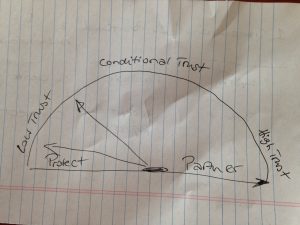
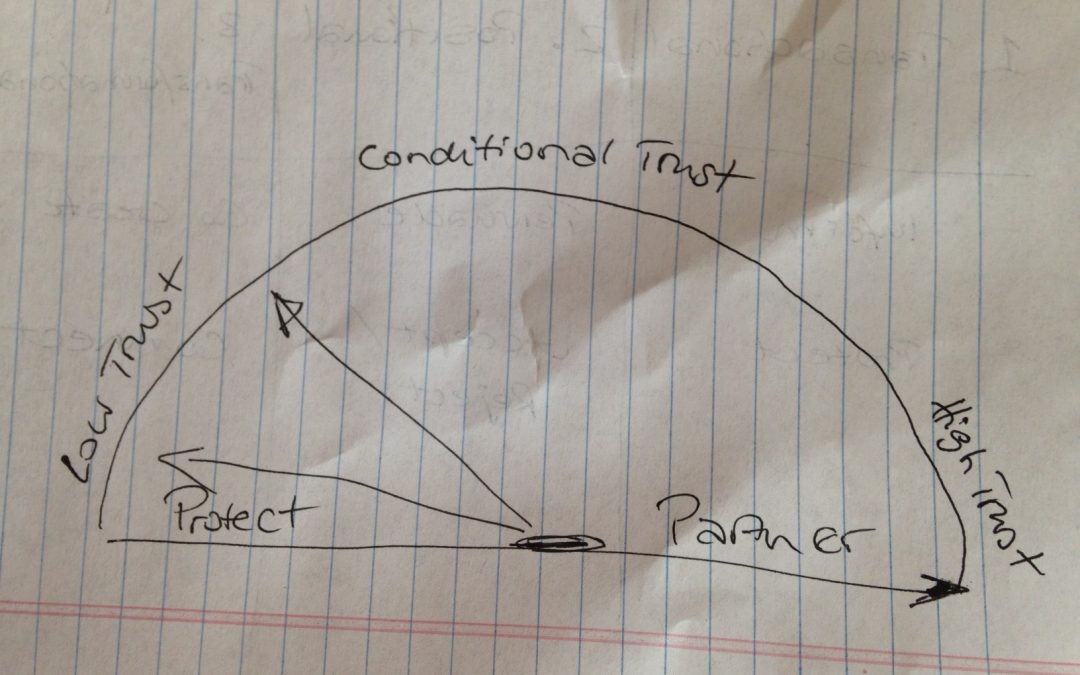
Next, I drew a simple dashboard and asked Bill to rate the level of trust he had in the CEO and his intentions. His answer was: low trust.
Then I asked him to consider the other direction. How much trust did he think the CEO had in him and his intentions? He had to admit that was probably low too.
So I asked him, as gently as I could: “How can you create agreement and collaboration with someone when the trust level is low and both of you are holding strongly to your positions?”
His response was simple. “I know. I haven’t figured that one out yet.”
And that’s the real issue.
When trust drops, we interpret things differently. Questions can sound like challenges. Disagreement feels more threatening. We listen for evidence that we’re right. We start preparing our response while the other person is still talking.
Conversational Intelligence describes this as moving toward protective rather than partnering behaviors. At the transformational level, the dynamic changes. We’re more willing to listen, explore what we don’t know and allow ourselves to be influenced.
That’s a very different conversation.
A communication disconnect isn’t always about communication skills
When leaders experience a communication disconnect, the natural conclusion is often, “We need to communicate better.”
Maybe.
But telling two people to communicate better is a little like telling them to “work together.” It sounds good. It doesn’t tell them what needs to change.
Sometimes the problem isn’t a lack of communication skills at all. It’s the mindset and emotional state we’re bringing into the conversation.
If I’ve already decided that you’re unreasonable, difficult or wrong, I’m going to listen to you through that filter. I may ask questions, but I’m not necessarily curious about the answers. I’m looking for an opening to prove my point.
That’s not listening. It’s waiting for my turn.
And leaders aren’t immune to this. In fact, the higher we move in an organization, the easier it can become to confuse experience and confidence with certainty.
We need strong convictions as leaders. We also need enough flexibility to consider that our interpretation may not be the only valid one.
The goal of a difficult conversation isn’t to win
Conversations should move something forward.
That doesn’t mean every conversation ends in agreement. Bill and the CEO didn’t necessarily need to leave that meeting agreeing with one another.
They did need to understand one another well enough to determine what should happen next.
There’s a significant difference between:
“How do I get him to understand why I’m right?”
and:
“What am I not understanding yet?”
The first question keeps me attached to my position. The second creates room for discovery.
That shift is at the heart of Level III, transformational conversation. It doesn’t require leaders to abandon their expertise, authority or point of view. It asks them to bring those things into the conversation while remaining open to what they don’t yet know.
That’s harder than it sounds.
What leaders can do when communication starts breaking down
When you notice yourself becoming frustrated, defensive or determined to make the other person understand your position, pay attention. That’s information.
Instead of pushing harder, get curious.
You might ask:
What am I trying to accomplish in this conversation?
Am I actually listening, or am I preparing my defense?
What does this situation look like from the other person’s perspective?
What assumptions am I making about their intentions?
What question could I ask right now that I genuinely don’t know the answer to?
And perhaps the most important one:
What am I doing that may be contributing to this communication breakdown?
That last question requires leadership.
It’s much easier to diagnose what’s wrong with the other person’s communication than to notice how our own behavior is shaping the interaction.
Leadership happens through conversations
Bill and the CEO missed an opportunity that day. Their conversation consumed time and energy without moving the issue or their relationship forward.
But one bad conversation doesn’t define a relationship.
The next conversation can be different.
That’s one reason Conversational Intelligence has remained part of my work long after completing my certification. It gave me language and tools for something I’ve seen repeatedly in coaching: the quality of leadership shows up in the quality of our everyday interactions.
Leadership isn’t only demonstrated in strategy meetings, major decisions or moments of crisis. It shows up when someone disagrees with us. When we feel challenged. When an employee disappoints us. When a colleague sees the situation completely differently than we do.
Those are the moments that reveal how we lead.
We can defend, push and prove.
Or we can become curious enough to discover something we couldn’t see from our own side of the table.
Sometimes that’s all it takes to turn a communication breakdown into a conversation that actually moves something forward.
If communication, trust or difficult conversations are getting in the way of your leadership or your team’s effectiveness, learn more about how I work with leaders