
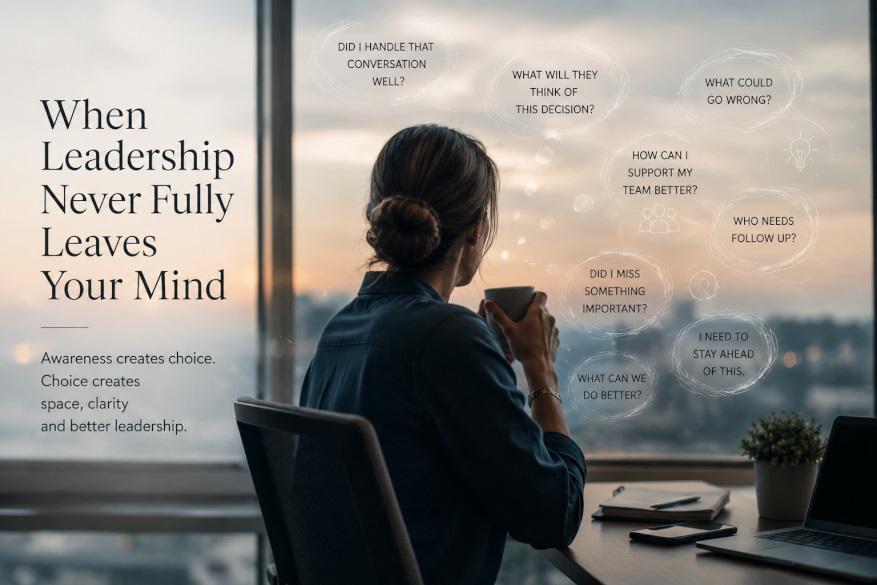
What many of us slowly get used to in leadership is the constant mental continuation of work.
The meeting ends, but internally it keeps going.
A conversation replays on the drive home.
An upcoming decision stays active somewhere in the background.
We rethink how something landed.
We analyze what we could have said differently.
We mentally prepare for reactions before they even happen.
Part of this comes from responsibility.
People depend on us.
The business depends on us.
Patients, clients, employees, timelines, outcomes.
There are real consequences attached to our decisions, and most thoughtful leaders take that seriously.
But another part comes from something more internal.
Many of us genuinely want to improve. We care about doing things well. We reflect on our behavior. We try to become more aware, more effective, more thoughtful in how we lead and communicate.
That is a strength.
The problem is not self-reflection itself. The problem is when reflection quietly turns into ongoing mental occupation.
At some point, the mind stops helping us process and starts keeping us psychologically “on” all the time.
I worked with a business owner who cared deeply about people and relationships. She wanted to communicate well, be fair, and create positive experiences for everyone around her. But over time, that came at the expense of her own sanity.
Because she doubted herself constantly, she absorbed other people’s reactions as proof that she had done something wrong. If someone became frustrated, disappointed, distant, or defensive, she immediately turned inward and started questioning herself.
Then the replaying would begin.
She would go over conversations repeatedly, trying to identify what she missed. She searched for the perfect response that would have prevented discomfort altogether. Hours of mental energy disappeared into rehashing interactions without ever arriving at real clarity.
What made this especially exhausting was that she could not see her own blind spots. She did not realize how much responsibility she was taking for other people’s emotional responses. She had not developed clear boundaries between what belonged in her lane and what belonged in someone else’s. So instead of evaluating situations calmly and responsibly, she stayed emotionally entangled in them long after they ended.
I think many high-functioning people do this to some degree. Not because they are weak. Usually the opposite.
Conscientious people often become highly self-monitoring. We pay attention. We want to improve. We hold ourselves accountable. We genuinely care about the impact we have on others.
But improvement can quietly become excessive internal pressure when every situation turns into another opportunity for self-correction.
At that point, even rest stops feeling restorative because mentally we never fully step out of evaluation mode.
Awareness changes a lot here. Not because awareness suddenly removes responsibility, but because it gives us more choice.
We begin noticing when a thought has already been processed enough. We can pause and ask ourselves whether continuing to replay something is actually useful, or whether the mind is simply trying to create certainty after the fact.
Sometimes there is something to learn.
Sometimes there is a conversation we need to have.
Sometimes we truly did mishandle something.
And sometimes the healthiest thing we can do is let the thought pass without climbing back into it again.
That requires trust.
Trust in ourselves.
Trust that we can handle difficult moments without endlessly rehearsing them afterward.
Trust that not every emotional reaction around us is ours to manage.
Trust that thoughtful leadership does not require permanent internal tension.
Interestingly, when that pressure starts to soften, many people do not become less responsible. They become clearer.
There is more recovery. More presence. More energy available for actual living instead of constant internal management.
And often, leadership becomes more grounded because we are no longer trying to control every possible outcome from inside our own mind.